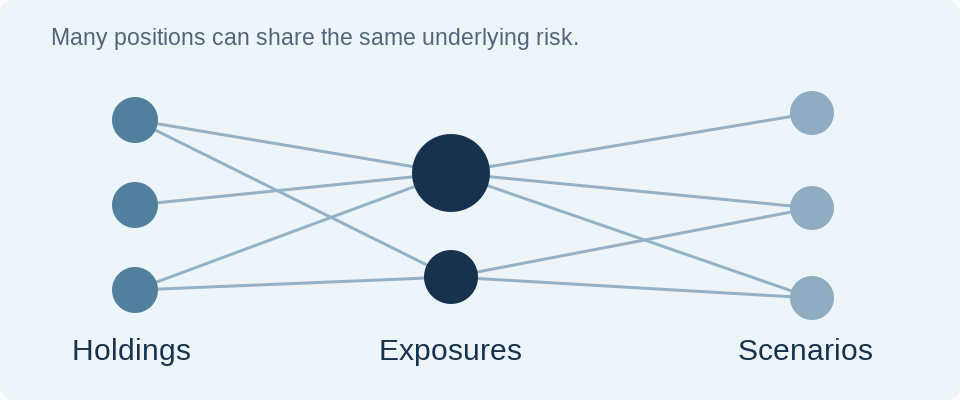
A new target weight leaves a trading decision unfinished. A fictional rebalance can make the implementation bill visible, but the reason for changing exposure still matters. An optional return signal, a required risk adjustment and a preference for tidier weights do not earn the same case for waiting.
- The fictional rebalance costs $20, or 2 basis points of portfolio value, under the stated assumptions.
- That arithmetic does not establish an optimal target or a worthwhile trade.
- Waiting saves an immediate implementation bill but can forfeit information that decays or leave an obligation unmet.
Fill in the trade before judging its merit
Take an explicitly fictional $100,000 portfolio split equally between two fictional funds. The hypothetical target becomes 60% in the first and 40% in the second. Holding prices constant, the assumed adjustment buys $10,000 of the first and sells $10,000 of the second. At an assumed 10 basis points on each traded leg, each leg costs $10. The total is $20, equivalent to 0.02% of portfolio value, or 2 basis points. This is stipulated arithmetic, not observed execution. (PyInvesting editorial calculation)
The filled record establishes the current weights, proposed weights, traded notionals and assumed proportional cost. It does not contain a forecast of benefit or establish that the target is optimal. Additional spread, slippage, impact and financing are excluded. Calling the adjustment cheap would still require a comparison with its purpose and feasible alternatives. The arithmetic only makes the stated implementation hurdle visible; it cannot show whether changing the exposure improves the fictional portfolio's prospective outcome. (PyInvesting editorial calculation)
Identify the consequence of leaving the position alone
The Bank of England's May 11, 2018 methods paper fits and selects predictive regressions under the loss relevant to the task. Its economic forecasting exercise finds value in that alignment. It does not evaluate the fictional funds, but it gives the rebalance question a useful distinction: an error must be defined before its cost can be compared with a trading bill. Missing a return opportunity and underestimating a consequential risk are different objectives, even when each leads to a changed weight. (Bank of England Research)
Assume first that the proposed adjustment is optional and motivated by a return signal. Waiting can then be compared with acting under a stated opportunity loss. Assume instead that an independently specified binding risk rule requires an adjustment. Saving transaction cost alone cannot authorise ignoring that rule; the comparison is among feasible ways to meet it. These are alternative decision conditions, not claims about a real mandate. They prevent an attractive fee calculation from deciding a question about obligations it never measured. (Bank of England Research)
Trade now, move partly or wait
AQR's December 2013 dynamic trading research considers expected returns, their evolution, risk, correlations and transaction costs jointly. Predictors can differ in decay rate and in their relationship with other signals. This makes the speed of adjustment an economic choice rather than an automatic consequence of a new target. The framework balances prospective benefits with risk and cost. Its summary does not supply the decay estimate, return expectation or optimal trading speed for the fictional portfolio. (AQR Research)
Under an optional signal, trading now reaches the proposed exposure promptly but pays the immediate bill. Moving partly accepts temporary exposure error while retaining some information; waiting pays no immediate trade cost but risks losing a decaying opportunity. If the signal changes slowly, a gradual response may preserve more of its purpose. If it expires quickly, delay becomes harder to justify. These conditional comparisons follow the decay mechanism, without inventing a return forecast or claiming which route wins for the fictional funds. (AQR Research)
Cheaper execution must preserve the intended exposure
AQR researchers use institutional trading records to investigate whether documented equity anomalies survive implementation. Their results differ across styles: value and momentum benefit substantially from cost aware optimisation, while rapid reversal strategies fail to survive costs at a reasonable scale in their study. This is more informative than declaring turnover universally harmful or universally necessary. A portfolio can preserve useful exposure while making cheaper implementation choices, but the scope for doing so depends on the strategy and the economics of the trades it requires. (AQR Research)
The cost research rules out a simple instruction to minimise turnover regardless of purpose. A lower bill can be achieved by abandoning the exposure the portfolio was meant to hold, which would change the strategy rather than improve its implementation. A useful comparison therefore records cost alongside the difference from the intended position. Partial adjustment earns a stronger case only if that temporary difference is acceptable under the objective. The historical style results motivate that tradeoff without transferring a cost estimate to the fictional funds. (AQR Research)
The missing benefit needs evidence of its own
BIS researchers examine volatility prediction across equities, bonds, currencies and commodities. Credit risk and funding liquidity proxies appear as recurring predictors, and their broader models improve on autoregressive benchmarks outside the estimation sample. Yet the gains vary by asset class and period. This is evidence that economic information can help a risk forecast, with an explicit boundary around its stability. It does not establish that adding the same inputs to every strategy will improve every portfolio or every trading decision. (BIS Research)
If an updated risk forecast motivates the target, its contribution must be evaluated at the intended asset and horizon before it enters the rebalance record. The BIS finding that predictive gains vary makes a generic confidence upgrade insufficient. The record should preserve what the forecast knew before the decision, then test whether the exposure rule used it usefully. A predictive relationship does not provide the missing expected benefit, nor does it turn the fictional implementation arithmetic into a measured net gain. (BIS Research)
The Federal Reserve volatility comparison reinforces that boundary. Its short horizon and monthly rankings differ, and machine learning does not consistently beat the broader econometric alternatives. It evaluates forecast losses alongside utility and risk measures rather than assuming one score settles every use. These findings explain why a forecast improvement must be matched to the decision it informs. They supply no preferred weights, expected alpha or profitability conclusion for the fictional rebalance. (Federal Reserve Research)
Editorial assessment. The filled example establishes a cost hurdle without inventing the benefit needed to cross it. Trade now obtains the hypothetical target immediately; partial adjustment accepts some temporary exposure difference; waiting preserves the current position while information may decay. Under an optional, slowly evolving signal, measured adjustment deserves consideration if it preserves the intended exposure more cheaply. Under a fast decaying signal, waiting requires a stronger defence. Under a binding risk rule, only responses consistent with that rule remain feasible. None of those conditional assessments identifies the fictional target as optimal or turns the small assumed fee into a profitability finding.
Evidence scope. The arithmetic is a constructed educational example, not an actual portfolio, backtest, fee quote or recommendation. It excludes additional spread, slippage, market impact, financing and other charges. No expected return, benefit or optimal weight is supplied. Historical forecasting and trading studies do not estimate those missing inputs for this case. This AI assisted analysis does not give personal investment advice.
Sources and further reading
- Linear and Nonlinear Econometric Models versus Machine-Learning Models: Evidence from Realized-Volatility Forecasting (revised September 2026)
- Dynamic Trading With Predictable Returns and Transactions Costs
- A Comprehensive Look at Financial Volatility Prediction by Economic Variables
- Predictive regressions under asymmetric loss: factor augmentation and model selection
- Trading Costs of Asset Pricing Anomalies
- Transparent fictional arithmetic for this article