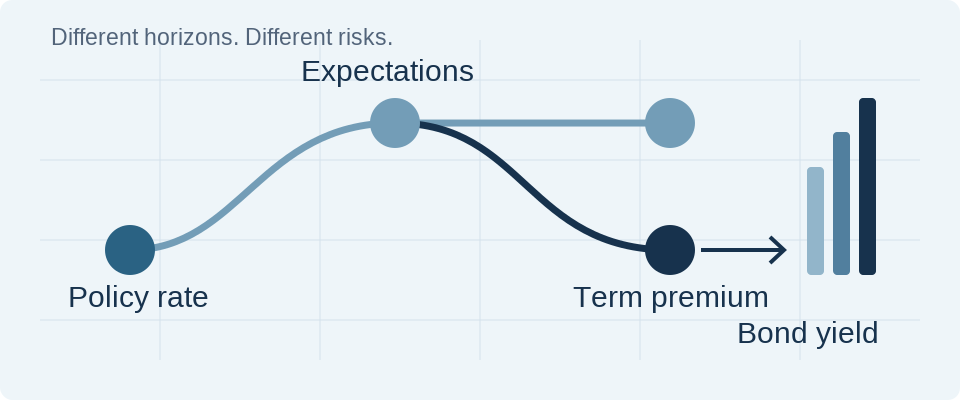
An announced rate increase answers what the central bank did. It leaves open what investors had anticipated and what they now expect after that decision. Reading the expected central bank policy path requires a comparison at a fixed horizon, with the economic conditions behind each expectation visible. Otherwise, a correct prediction of the immediate action can conceal a mistaken interpretation of the news.
- Compare the anticipated action with the announcement before calling it a surprise.
- Record later meetings separately from the current setting.
- Treat a policy path as conditional on economic developments, with competing yield explanations checked.
Begin with an unchanged action and a changed interpretation
Consider a qualitative thought experiment. Before an announcement, an observer expects an increase and then expects the higher setting to persist. The increase arrives, but the accompanying message changes the observer's view of that persistence. The immediate action has matched the expectation while the expected sequence has changed. This is a stipulated comparison, with no meeting probabilities or market prices attached. Federal Reserve research separating target news from path news supplies its economic rationale. (Federal Reserve)
The Federal Reserve's September 16, 2026 statement records an increase alongside elevated inflation, resilient spending, strong productivity and robust capital investment. Those observations establish the announced action and the Committee's stated economic assessment. They do not reveal what an observer expected beforehand. A reader cannot infer the surprise merely from the decision's direction, nor infer that every future meeting will repeat the action because the statement describes conditions supporting it. (Federal Reserve)
Make the before and after record explicit
The useful record has distinct entries for the action expected before publication, the action announced, and the sequence expected afterward. In the thought experiment, the action entry stays consistent while the persistence entry changes. The inference is therefore about future policy rather than a missed prediction of the current decision. The Federal Reserve study finds that announcement effects require separate target and path factors, which is precisely why collapsing these entries loses economically relevant information. (Federal Reserve)
The record also needs a timestamp. The ECB paper Measuring euro area monetary policy distinguishes decision releases from press conferences and finds different information across those windows. Applied to the thought experiment, a revision after the explanation should be assigned to that stage rather than silently attributed to the decision headline. This is a proposed reading method, not a reconstruction of an actual event. Its purpose is to preserve when the observer learned something new.
State what would justify changing persistence
Return to the September Fed assessment as a reference point. Suppose subsequent information changes the observer's interpretation of inflation or the resilience of spending. A revised persistence judgment should explain how that information changes the assumed need for the setting to continue. The official assessment names relevant economic conditions without furnishing a complete formula for future decisions. The analyst must therefore expose the conditional reasoning rather than present an inferred sequence as an official commitment. (Federal Reserve)
The IMF paper A Macroeconomic Approach to the Term Premium connects rate forecasts to growth, inflation and monetary policy within a macroeconomic term structure model. Its discussion includes the possibility that an inflation surprise requires faster tightening than anticipated. This establishes a reason to connect expected policy to economic assumptions. The historical model does not provide the current observer's assumptions, a present meeting forecast or a numerical answer for the thought experiment.
Ask whether the revision concerns timing or the destination
A revision to the timing of the next adjustment need not revise the setting expected much further ahead. The ECB communication research distinguishes timing and guidance information from news affecting longer maturities. That finding supports keeping the horizon fixed when comparing expectations. If the observer shifts an anticipated adjustment closer but leaves the later destination unchanged, the record should say so. Calling every timing revision a new lasting policy regime would overstate what the comparison establishes. (European Central Bank)
A destination claim carries a greater economic burden. In the IMF macroeconomic framework, expectations further ahead depend on an account of growth, inflation and policy over that horizon. An analyst who argues for lasting persistence should explain why the relevant disturbance lasts or changes the longer outlook. A temporary timing revision can be consequential without meeting that burden. This distinction makes the thesis contestable: evidence of a fading disturbance could weaken persistence while leaving the earlier timing judgment intact. (International Monetary Fund)
A bond move can support the reading without settling it
The New York Fed's The Term Structure of Expectations and Bond Yields separates expected shorter rates from compensation for holding duration using professional forecasts. Its findings assign a substantial role to that compensation in yield variation. A longer yield therefore contains information beyond expected decisions. For this article's question, the implication is narrow: a yield movement can motivate an investigation of the expected sequence, but cannot substitute for the before and after expectations record.
A competing interpretation is that the yield changed because the market had different duration exposure to absorb. BIS research on government bond supply identifies that mechanism through the debt left for private investors and its maturity exposure. If evidence supports a supply change while expectations about later decisions remain stable, the policy path explanation deserves less weight. The competing mechanism matters here because it could invalidate the inference, rather than because every meeting requires an extended bond valuation exercise. (Bank for International Settlements)
The evidence that would reverse the assessment
An apparent expectations revision may also reflect a revised estimate. BIS research explains that term premium models depend on parameters, updated information and, in some specifications, revised macroeconomic data. If the claimed policy revision appears only after changing those inputs, it should not be described as an observed announcement surprise. A stable comparison should preserve the information date and disclose the method, leaving changes in the model separate from changes in the observer's economic view. (Bank for International Settlements)
The path interpretation becomes more persuasive when an expectations measure at the relevant horizon changes in the direction the stated economic reasoning predicts. It weakens when that measure remains stable and the bond movement is better explained elsewhere. The survey approach in the New York Fed paper illustrates why expectations deserve their own evidence. The consequence for portfolio research is a more specific exposure thesis: dependence on future settings should not be confused with dependence on a bond's changing risk compensation. (Federal Reserve)
Editorial assessment. The thought experiment holds the immediate decision fixed while allowing the expected persistence and timing to change. It produces a concrete interpretive test: identify the entry that changed, the publication stage that changed it and the economic assumption responsible. Unlike a general explanation of bond yield components, the conclusion concerns what counts as news about later meetings and what evidence could overturn that reading.
Evidence scope. The scenarios are qualitative assumptions, not model outputs or observations of current pricing. Historical research establishes mechanisms. No new expectations series, event study or meeting probability is estimated, and no portfolio return follows from the comparison.
Sources and further reading
- Federal Reserve issues FOMC statement
- Do Actions Speak Louder Than Words? The Response of Asset Prices to Monetary Policy Actions and Statements
- The Term Structure of Expectations and Bond Yields
- Measuring euro area monetary policy
- A Macroeconomic Approach to the Term Premium
- Government bond yields and the dynamics of duration supply
- Term premia: models and some stylised facts