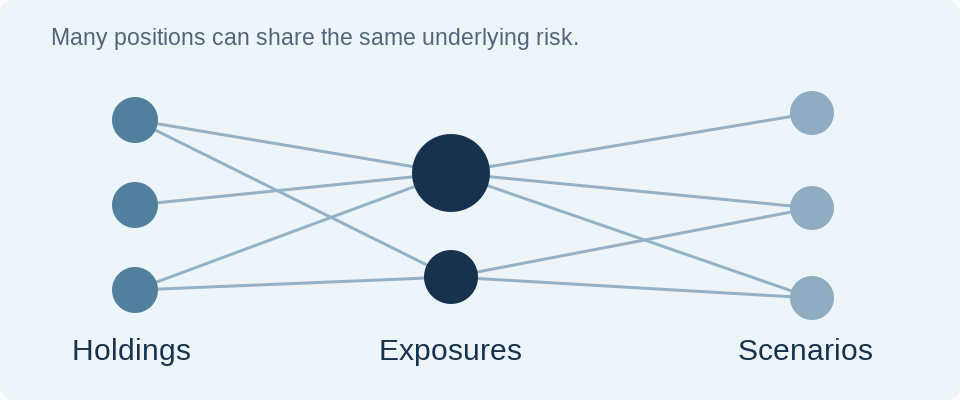
Two fund names do not establish two independent sources of exposure. To examine overlapping holdings across investment funds, start with the investor's weight in each vehicle, then follow that capital to the issuer inside it. The arithmetic can reveal a dependency concealed by product count. It cannot, by itself, tell the reader how much volatility or loss that dependency will create.
- Multiply each fund allocation by its issuer weight, then combine repeated issuers.
- Treat unknown remaining holdings as unresolved exposure.
- Ownership weights, factor sensitivities and defensive performance require different evidence.
Follow the capital through both vehicles
Assume Fund A receives 60% of an entirely fictional portfolio, with 40% allocated to Fund B. In a common hypothetical holdings snapshot, Fund A's position in fictional Issuer X is 50%; Fund B's position in X is 25%. Multiplying the allocations by these positions gives contributions of 30% through A and 10% through B, adding to 40% total exposure. Every input is an educational assumption, not an actual holding or recommended allocation. (PyInvesting editorial calculation)
The calculation changes the question posed to the second fund. Its different name does not remove the issuer already held through the first vehicle. Its contribution adds to the combined dependency. Nothing is specified about either vehicle's other investments, so the example cannot establish their full overlap or the diversification of the rest of the portfolio. It describes ownership at the stipulated snapshot, with no issuer return, correlation, loss probability or performance forecast attached. (PyInvesting editorial calculation)
The ECB's account of euro area equity fund concentration shows why aggregation deserves attention. At the end of 2024, almost 30% of the sector's nonfinancial corporate equity portfolio was held in 25 companies. The observation concerns aggregate fund holdings in that defined category, rather than every fund or all investment assets. The ECB also describes how a shock to a concentrated issuer or sector can affect fund valuations and prompt investor withdrawals. (ECB Research)
Ownership is the first result, not a complete risk measure
The ownership exercise identifies where capital depends on an issuer. It does not convert that capital share into a volatility contribution. A Federal Reserve study of bank equities illustrates why: bank returns can reflect common market, size, value, term and default exposures alongside more specific risks. Applying that distinction here requires a risk model and relevant estimates. An ownership total is useful precisely because it states what is known before those additional assumptions enter. (Federal Reserve Research)
Different issuers can also share common drivers. In the bank equity framework, the absence of a repeated company would leave systematic factor exposures unresolved. A second fund might reduce direct overlap while preserving sensitivity to the same broad market or credit conditions. That is a conditional possibility, not a finding about the fictional funds' unknown positions. It means a sensible assessment reports issuer aggregation and factor analysis separately rather than relabelling either one as complete diversification. (Federal Reserve Research)
The ECB concentration mechanism adds a further distinction between capital exposure and the response to losses. A valuation decline can trigger withdrawals, after which funds may liquidate assets. The ownership calculation does not estimate those flows, but it identifies where a common valuation shock could begin. If repeated issuers dominate the known holdings, the next research question concerns the funds' ability to meet redemptions without relying on the same exit, rather than merely counting their remaining names. (ECB Research)
A common trading channel can survive different holdings
The ECB's analysis of passive investing describes managers trading baskets to track an index when money enters or leaves and when index composition changes. Such trading can increase common movements among constituents. Its euro area empirical discussion reports an association between greater passive ownership and stronger correlation with the broad market. The mechanism concerns shared trading and return behaviour, not only repeated issuer ownership, and the association does not establish the same effect for every fund. (ECB Research)
Suppose the issuer aggregation shows limited overlap but the vehicles track related baskets. The ECB mechanism gives a reason to investigate whether their responses to flows still share an exit channel. Conversely, a repeated issuer does not prove that both funds will trade it simultaneously. These are different hypotheses requiring different observations. Keeping them separate avoids overstating the ownership result while preserving its value: it reveals an actual common capital dependency wherever the holdings are known. (ECB Research)
AQR's Total Portfolio Approach discussion identifies advantages and possible risks in removing traditional allocation guardrails. The relevance here is the choice of unit for evaluation. Looking across vehicles can make repeated exposures visible, but a broader view also requires a clear account of the constraints being relaxed. The manager discussion does not prove that combining every allocation decision improves performance, or that a concentrated exposure is necessarily unintended or unsuitable for the portfolio's objective.
Judge the additional holding against its intended job
Deliberate concentration can be evaluated coherently once it is visible. Under the total portfolio perspective discussed by AQR, the relevant judgment is whether the combined dependency fits the objective and the permitted risk, rather than whether each fund separately appears broad. If the purpose of adding a fund was to reduce an existing issuer dependency, discovering that it reinforces the same position weakens the case for calling that addition diversification. It says nothing automatic about the issuer's prospective return. (AQR Research)
AQR's study of equity drawdowns distinguishes ordinary diversification from investments expected to perform well during bad periods. It also identifies a tradeoff between better hedging characteristics and average performance. That distinction applies after ownership is aggregated. A holding that changes the issuer mix may broaden exposure without supplying protection during the specific loss the reader fears. Its contribution should be described in terms of the job it actually addresses, not a universal claim of safety. (AQR Research)
The practical conclusion is to resolve ownership before promising defence. If an added fund lowers a known issuer dependency, that supports one narrow diversification claim. If it leaves the dependency unchanged or increases it, the claim needs a different rationale. Whether the addition protects during an equity drawdown remains the separate question identified by AQR. This sequence makes a useful capital calculation actionable without pretending it supplies the risk model, stress behaviour or future payoff that the calculation never measured. (AQR Research)
Editorial assessment. The fictional example demonstrates the aggregation rather than merely describing a checklist. It then places a boundary around the result: combined issuer ownership is known under the assumptions, remaining positions are unknown, and factor and redemption dependencies need further evidence. The assessment of an additional fund therefore begins with the specific dependency it changes, before extending to a claim about risk or defensive performance.
Evidence scope. The arithmetic uses fictional inputs solely to illustrate ownership. It contains no direct holding, derivative or leverage assumption, no recommended weights and no return forecast. The ECB aggregate observation has a defined end 2024 scope; its publication date is unestablished in the retained record. No actual fund portfolio is assessed.
Sources and further reading
- Annual Report 2024: The evolution of concentration risk in euro area equity funds
- Modeling Bank Stock Returns: A Factor-Based Approach
- Passive investing and its impact on return co-movement, market concentration and liquidity in euro area equity markets
- Total Portfolio Approach
- It Was the Worst of Times: Diversification During a Century of Drawdowns
- Transparent fictional arithmetic for this article