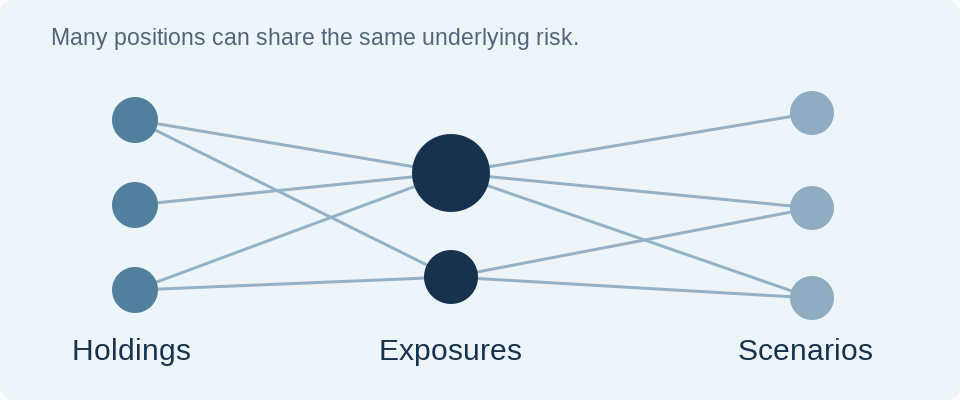
For an investment committee delegating allocation decisions, greater flexibility creates an immediate accountability question. The manager may be authorised to use one definition of risk and later judged through another. A total portfolio mandate should make that mismatch visible before it happens. The point is to connect discretion with an owner and a reviewable result, rather than assume that removing boundaries improves returns.
- Name the decision owner before delegating portfolio flexibility.
- Use compatible definitions for risk permission and attribution.
- Specify what triggers review when liquidity or tail exposures change.
A mismatch that ordinary performance reporting can miss
Consider a hypothetical investment committee that permits a manager to shift exposures across asset classes, judging risk at the whole portfolio level. It later evaluates the manager only against fixed asset class allocations. The permission and the evaluation now describe different decisions. This is a governance thought experiment, not an account of a real institution. IMF guidance on sovereign wealth funds supplies the consistency principle by linking active risk measurement with attribution along the same factors or decision variables. (IMF Research)
The mismatch matters even when the return is measured correctly. Under the hypothetical permission, departing from an asset class weight may be part of the assigned task. Under the later evaluation, the same departure can appear to be the failure itself. The IMF framework's emphasis on delegation and accountability suggests resolving that ambiguity in advance. Otherwise the committee learns whether a benchmark was exceeded without learning whether the manager used the intended discretion well. (IMF Research)
Write the objective before the permission
The IMF's Sovereign Asset Liability Management guidance ties strategic allocation to a specified investment objective and to explicit or implicit obligations. Its setting is resource rich economies, where smoothing revenue and spending across time creates important balance sheet tradeoffs. The institutional lesson is that asset choice answers an objective involving obligations. It does not establish a universal allocation or imply that every delegated portfolio faces the same liabilities as a sovereign wealth fund. (IMF Research)
For the hypothetical mandate, write the objective as meeting the institution's specified obligations while managing the aggregate investment risks it authorises. The committee must state those obligations rather than borrow a generic return target. Delegated choices then concern how the manager may alter exposures to pursue that objective. This is an application of the IMF balance sheet principle. It makes the mandate intelligible before any preference for fixed allocation boundaries or wider flexibility enters the decision. (IMF Research)
Make the mandate a reviewable assignment
The hypothetical assignment is specific. The committee owns the objective and approves permitted risks; the manager owns exposure changes within that permission. For this example, aggregate risk means combined issuer concentration and financing exposure across all delegated holdings. The review attributes outcomes through those same exposures. AQR's discussion identifies benefits and risks from removing allocation guardrails. Replacing a removed boundary with this explicit assignment is the proposed control, not a measured performance benefit. (AQR Research)
The review evidence should show what changed, why the change served the objective and whether the aggregate exposure remained within the authorised definition. Escalation occurs when a proposed decision no longer fits that permission, rather than after a disappointing result is relabelled as unauthorised. In the AQR framing, removing guardrails has countervailing risks. The committee therefore needs to know which risk a boundary previously controlled and what evidence now performs that function under the broader mandate. (AQR Research)
A preferred strategy cannot substitute for the mandate
AQR's August 2026 case for a total portfolio approach advocates portable alpha as an alternative to other methods of seeking returns beyond broad equity exposure. Its account begins from a manager view of expected returns and institutional targets. That is attributed advocacy, not an independently established promise that a strategy will close a target gap. The governance question remains even if a committee finds the argument persuasive: who is authorised to take the resulting exposures and how will the decision be evaluated? (AQR Research)
If the hypothetical committee adopts that strategy, the permission must identify the risks the implementation uses and the attribution required to assess it. A strategy name does not answer either question. AQR itself notes that diversification leaves the possibility of losses. The relevant governance comparison is therefore between an explicit, reviewable assignment and an ambiguous one. The article makes no judgment that portable alpha, private equity or active management is the preferred route for the institution's objective. (AQR Research)
Assign the difficult scenarios to an owner
BIS research on the cumulant risk premium studies risks beyond the familiar mean and variance using leveraged ETFs. It reports especially strong exposure of highly leveraged strategies to higher distributional moments and a larger premium in stress. The relevance is a possible mismatch between the portfolio's actual exposures and a mandate described only through ordinary variability. The paper does not establish that every conventional risk budget fails or that a particular delegated portfolio contains those strategies. (BIS Research)
If leverage makes those exposures relevant, the hypothetical committee should assign responsibility for reviewing the scenario before granting the related discretion. The manager's ordinary risk report may be accurate while leaving the authorised tail exposure unclear. Under the BIS mechanism, the review should ask what happens when the distribution changes shape, not simply whether average variability remained acceptable. The escalation owner is the committee when that risk sits outside the permission; the manager must identify the proposed change. (BIS Research)
Accountability includes the ability to meet an exit
The ECB's fund concentration discussion describes a chain from losses in a heavily held issuer or sector to withdrawals and possible asset liquidation. This adds a funding and implementation question to the mandate. A portfolio can be assessed for investment exposure while the conditions under which holdings must be sold remain less clear. The documented mechanism supports asking who owns the response to outflows; it does not predict withdrawals or a liquidity failure in the hypothetical institution. (ECB Research)
Suppose the proposed exposure change increases dependence on a shared exit under withdrawals. The committee should decide whether that dependency belongs within the existing permission, while the manager provides the holdings and liquidity analysis needed for review. The ECB mechanism explains why this is more than a reporting preference: the response to losses can change what the portfolio must do. Broader discretion deserves greater confidence when the mandate can explain that response and identify who must approve a departure from it. (ECB Research)
Editorial assessment. The hypothetical mandate identifies an objective owner, a delegated exposure decision, a common risk definition, review evidence and an escalation condition. Its central test is the permission and attribution mismatch: would a decision authorised at portfolio level later be judged solely through fixed allocation boundaries? Resolving that mismatch makes flexibility accountable without claiming that it creates a superior allocation or measured return improvement.
Evidence scope. The mandate is a proposed governance example for delegated institutional portfolios. IMF sovereign guidance and manager advocacy retain their respective settings. No numeric risk budget, liability schedule, strategy return or implementation benefit is invented, and the hypothetical committee has no actual portfolio attached.
Sources and further reading
- Sovereign Wealth Funds: Aspects of Governance Structures and Investment Management
- Total Portfolio Approach
- The Case for Taking a Total Portfolio Approach
- Sovereign Asset-Liability Management: Guidance for Resource-Rich Economies
- The cumulant risk premium
- Annual Report 2024: The evolution of concentration risk in euro area equity funds