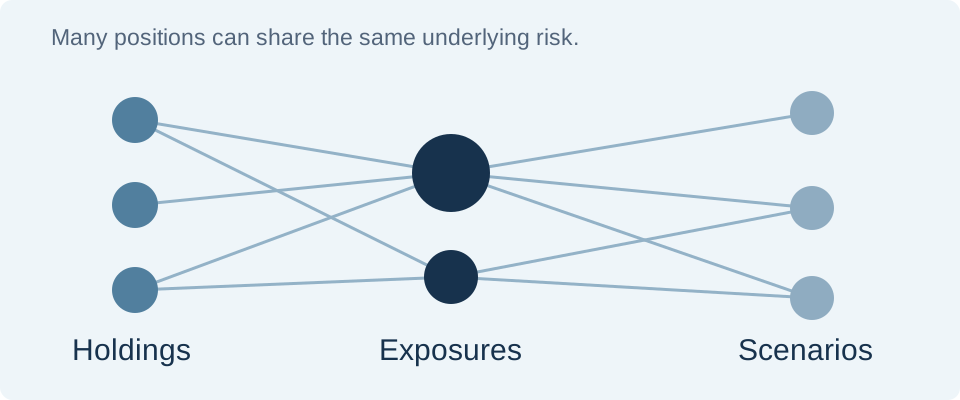
A useful AI tool and growing supplier sales can look like independent confirmation of an investment thesis. They deserve closer inspection when the supplier also helps finance the buyer. AI demand and connected financing can reinforce each other through equity stakes and purchase commitments. The analytical task is to identify which cash flow stands on its own, while giving productive adoption the credit its evidence actually supports.
- User productivity and supplier cash generation are different outcomes.
- Funding and purchase commitments can share one counterparty dependency.
- Connected financing does not prove demand is artificial, but it changes the evidence needed to judge durability.
Follow the investment back to the purchase
A September 2026 BIS discussion describes chip manufacturers and hyperscalers taking equity stakes in AI firms that commit to buying their chips and computing services. It identifies these circular financing links as difficult to observe and sometimes difficult to value. The same account describes a growing role for debt and private credit in funding the investment boom. These relationships supply a concrete reason to distinguish a purchase commitment from evidence that the buyer can sustain purchases independently. [6]
Consider the relationship conceptually, without assigning it to a company. A supplier invests in a buyer, and the buyer commits to purchasing the supplier's output. The investment and the order may both be real, but they share a funding link. Counting each as independent confirmation would overstate the breadth of support for demand. The BIS description motivates asking whether the buyer's operational cash generation can sustain the purchase after the connected funding is exhausted or changes. [6]
Productive use establishes value at a different point
The NBER workplace study Generative AI at Work examines the introduction of a conversational assistant among customer support workers. It reports gains in issues resolved per hour, with larger improvements among less experienced workers and more limited effects among experienced workers. It also reports improvements in customer sentiment and employee retention. This is evidence that a particular deployment can improve workplace outcomes. It is not an estimate of current infrastructure provider margins or a measurement of the buyer financing relationships described by BIS. [7]
A user can capture value through better task performance while the distribution of that value between user and supplier remains unresolved. The workplace study supports the productivity premise, not the commercial contract that transfers part of the benefit. The supplier thesis therefore needs a bridge from useful output to payment and collection. Without it, stronger user performance cannot determine whether the provider earns an adequate return on the infrastructure and financing committed to deliver the service. [7]
The IMF's April 2025 European productivity paper uses a framework for incremental gains from AI adoption rather than larger transformative effects over a longer horizon. This scope matters to the value argument. A task based estimate concerns how productive capacity may improve under the model's assumptions. It does not settle which commercial participant captures the gains or how quickly customer payments can cover a supplier's investment. The model's object and the financing thesis remain separate. [4]
The strongest defence of connected finance deserves a fair test
Connected financing could support adoption of a technology that produces real value. The incremental productivity framework in the IMF paper gives an economic reason to take that possibility seriously: beneficial task changes can exist before any claim of transformation is established. The important distinction is between financing that bridges adoption and financing that remains essential to sustaining purchases. The model does not choose between those commercial states. Evidence about the buyer's use, payment capacity and continuing need must do that work. [4]
The IMF's September 2026 patent study examines AI and productivity across OECD countries using data from 2000 to 2017. It finds that occupational composition matters and that gains from complementarity can take time as workers learn. The study supports attention to the timing and distribution of benefits. Its historical setting does not test the present infrastructure buildout, nor establish that an individual buyer's productivity gains will arrive before its financing obligations need to be met. [5]
If operational benefits arrive slowly while purchase commitments begin earlier, the timing gap becomes part of the demand assessment. The patent study's learning mechanism makes such a gap plausible without quantifying it for any firm. A durable financing thesis should explain what funds the interval and what evidence would show that benefits are converting into payment capacity. Productive use and financing fragility can coexist; acknowledging that possibility gives the adoption evidence a precise role instead of dismissing it. [5]
Ask which entity must generate the cash
The BIS January 2026 bulletin anticipates a shift from operating cash flows toward debt to meet AI investment needs, with private credit playing a larger role. It links sustainability to firms meeting high earnings expectations and notes a tension between equity and debt market pricing. This earlier assessment frames the financing burden. It is not a current measurement of every company's funding mix or proof that a specific borrower cannot honour its commitments. [3]
For the supplier thesis, stronger evidence would connect use to revenue that becomes cash without depending on repeated support of the same buyer. For a lender thesis, the focus shifts to the borrower's resources for meeting obligations while gains develop. The BIS financing discussion supports distinguishing these dependencies. The interpretation should favour durable commercial demand when collection and operating capacity support it; it should remain conditional when the main evidence is another commitment backed by connected funding. [3]
Aggregate strength cannot settle the commercial link
The ECB's September 2026 activity assessment identifies increased AI related activity in digital services, investment and exports. It also describes a resilient economy with several other sources of support. Those observations establish that activity is visible at an aggregate level, rather than that every AI provider has profitable independent demand. The commercial question survives a strong macroeconomic backdrop: which entity receives cash, from whom, and with what reliance on the financing relationship? [2]
The Fed's September statement similarly describes robust capital investment and strong productivity without assigning all of either to AI. Using that assessment to certify an AI supplier's economics would skip both attribution and value capture. The research consequence is to keep the unit of analysis fixed. Economy wide activity can support the setting, workplace evidence can support useful deployment, and financing evidence can expose a counterparty link. None automatically replaces the cash flow evidence required for the entity under consideration. [1]
Editorial assessment. The analysis follows a supplier investment into the buyer's purchase commitment, then asks whether productivity creates cash capable of sustaining that purchase independently. It gives the strongest alternative a fair hearing: connected finance may bridge valuable adoption. The dividing evidence concerns continuing payment capacity and collection, rather than whether an order exists or the technology is useful somewhere in the economy.
Evidence scope. No company contract, default probability, profitability estimate or additional arithmetic is invented. Historical workplace and patent findings do not estimate the current buildout's returns. Connected finance is not treated as proof of fictitious demand, and no current provider's collection record or funding terms are assessed.
Sources and further reading
- Federal Reserve issues FOMC statement
- Monetary policy statement: economic activity
- Financing the AI boom: from cash flows to debt
- Artificial Intelligence and Productivity in Europe
- Artificial Intelligence and Aggregate Labor Productivity: Evidence from Patent Data
- Artificial intelligence, growth and financial stability: challenges for central banks
- Generative AI at Work