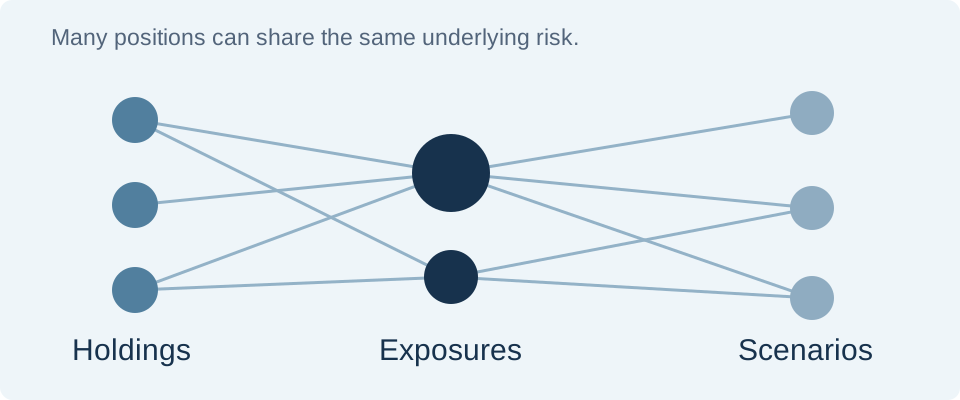
A coherent risk model can still turn fragile estimates into a precise allocation. The decisive test is whether the same portfolio decision survives plausible changes in dependence and tail assumptions. Adding model detail is useful only if it addresses the uncertainty driving that action.
- Model structure can be adequate while calibrated dependence and tails remain unreliable.
- A sensitivity exercise should preserve the same decision, objective and horizon.
- Credit simulations, market risk models and leveraged funds answer different questions.
- A better forecast statistic does not establish a better allocation rule.
Find the uncertain input before adding structure
A BIS credit risk study distinguishes structural misspecification from calibration error in simulated portfolios. Violating certain simplifying assumptions has little effect in that experiment. Plausible errors in estimated dependence, and mistaken assumptions about return tails, instead create substantial inaccuracies. The implication is specific: adding structure would address a different problem from improving unreliable inputs. The finding concerns simulated credit portfolios; it supplies no numerical sensitivity for an equity and bond allocation. [1]
Start the proposed diagnosis by holding the portfolio, objective and action under review fixed. Vary the dependence and tail inputs plausibly questioned by the credit calibration findings, without transferring that study's coefficients. If the action reverses under modest credible alternatives, confidence rests on a narrow calibration. If it remains stable, the case is less dependent on that input. Adding structural complexity should then be tested against the identified source of fragility rather than presumed to cure it. [1]
Keep the action and the model's purpose fixed
Bank of England research on filtered historical simulation examines risk estimates conditioned on recent returns. It considers how filtering changes distributional properties and procyclicality, and asks whether the objective is a return percentile or a broader risk management purpose. That distinction gives a calibration diagnosis an endpoint. A model may be satisfactory for its statistical target while leaving the decision using that statistic unevaluated. The paper addresses market risk methodology, rather than the BIS credit simulation. [2]
Responsiveness to recent returns can also be useful without being sufficient. The Bank of England discussion supports testing whether a risk estimate adapts in the way needed for its purpose, while examining the consequences of that adaptation for the portfolio rule. A responsive estimate could alter exposure quickly; the value of that change would depend on what follows and on the cost of adjustment. This is a conditional implementation question, not a finding that responsive models always amplify losses. A model can forecast a statistic well while the action attached to it remains poorly designed. [2]
Federal Reserve volatility research compares forecasting models across horizons and several statistical and portfolio related criteria. Rankings depend on the horizon, while machine learning does not systematically beat the wider econometric set. This gives a reason to attach the intended decision horizon to any claim of model improvement. It does not establish a generally preferred model or show that a gain at one horizon survives a different allocation rule. The forecasting result needs that practical boundary. [4]
Next hold the holding horizon fixed when testing a revised model. A better short horizon statistic cannot settle a longer allocation decision simply because both use volatility. The Federal Reserve horizon rankings make that mismatch consequential. Compare candidate and benchmark on the information and target appropriate to the same action, then examine whether any improvement survives the allocation rule. This distinguishes a repaired forecast from a repaired decision, neither of which is estimated here. [4]
Change a relevant assumption and follow the same decision
The ECB's analysis of stock and bond correlations warns that historical return distributions may not represent volatile conditions. It describes how supply shocks can raise inflation while weakening output, creating simultaneous pressure on bond values and expected equity distributions. Higher return correlation can then cause the portfolio to experience more risk than its historical calibration implied. The mechanism concerns a change in the environment, rather than an error in arithmetic. A model that accurately summarises the earlier sample can still be poorly matched to the economic conditions under which the portfolio is now being evaluated. [3]
For an allocation relying on stock and bond diversification, the ECB's supply shock mechanism supplies a reason to question historical dependence. Hold the decision objective fixed and compare the original dependence assumption with a scenario in which the shock pressures both assets. If the allocation changes materially, identify which protection assumption failed. This is an assumption diagnosis without assigned probabilities or a calculated allocation. A favourable calm sample does not resolve the economic relevance of the alternative. [3]
BIS research on cumulant risk examines properties of return distributions beyond ordinary variance. Its leveraged fund methodology finds that compensation for those properties varies across asset classes and becomes material during stress, with heavily leveraged strategies particularly exposed. This evidence supplies another boundary around a conventional covariance view. Dependence among ordinary fluctuations is not the only feature relevant to a difficult outcome. The findings do not validate a specific stress model for another portfolio; they justify examining what information about asymmetric or extreme returns the chosen risk system may leave outside its central estimate. [5]
Stress testing dependence assumptions should ask what features of a severe outcome could escape the ordinary risk measure. Following the BIS cumulant evidence, an analytical review could examine the interaction of leverage with distributional shape, rather than scaling a calm period estimate mechanically. Keep the stress result identified as a scenario conditional on its inputs. The watchlist then compares realised difficult episodes with the mechanism the scenario described. Repeatedly missing the same loss channel would weaken confidence in the model, even if its ordinary variation forecasts continued to appear accurate. [5]
Carry the diagnosis into actual portfolio construction
AQR's full Academic Alpha paper describes how a research signal must be converted into positions with decisions about sizing, risk allocation, unintended exposure and transaction cost efficiency. It also notes that some documented factors overlap earlier patterns and others cannot be implemented usefully after costs. The manager's argument concerns construction and implementation, with commercial context. It illustrates the gap between a potential diversifier and the actual portfolio that holds it: measured signal properties are inputs to a design process, while the positions, risks and costs created by that process require their own assessment. [6]
A strategy's diversification claim needs the same discipline. Trace the signal through the positions actually held, the exposures those positions create and the costs required to maintain them. The AQR implementation discussion motivates reviewing unintended common drivers before granting the strategy protection credit. A low historical relationship may be promising evidence, while the portfolio still needs a test of what happened when its main risk source suffered. Confidence should grow from that connected evidence. It should shrink when a precise model or an appealing strategy description is used to bypass the uncertainty between the claim and the realised portfolio. [6]
Editorial assessment. The proposed diagnostic asks which single assumption changes the action, then whether evidence can resolve that assumption at the required horizon. If reasonable alternatives leave the decision intact, the allocation has a more robust case even when the precise risk estimate varies. If small plausible changes reverse it, the numerical precision overstates decision confidence. A richer model deserves influence when it repairs the identified weakness across those alternatives, rather than merely producing a more elaborate central estimate.
Evidence scope. The BIS calibration result concerns simulated credit portfolios and cannot be transferred numerically to every asset allocation. Other sources study different models, horizons and instruments. No new covariance matrix, distribution, portfolio optimisation or validation series has been calculated. The framework diagnoses dependencies and evidence gaps; it does not estimate current risk, certify a strategy's diversification or forecast a future loss.
Sources and further reading
- Modelling and calibration errors in measures of portfolio credit risk
- Filtered historical simulation Value-at-Risk models and their competitors
- Cross-asset correlations in a more inflationary environment and challenges for diversification strategies
- Linear and Nonlinear Econometric Models versus Machine-Learning Models: Evidence from Realized-Volatility Forecasting (revised September 2026)
- The cumulant risk premium
- Academic Alpha