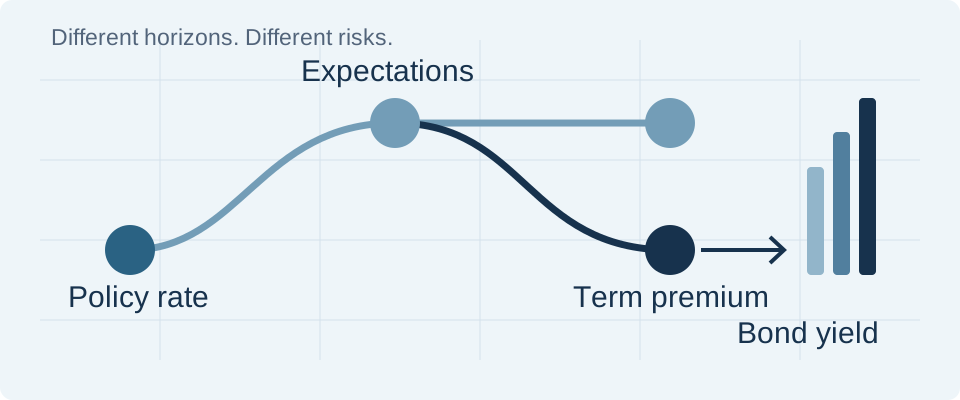
A fiscal risk premium can raise more than the government's borrowing cost. Because sovereign yields act as private financing benchmarks, repricing can tighten credit conditions for households and firms and weaken demand. Identifying that transmission is a separate task from proving the fiscal cause or inferring the central bank's response.
- Fiscal repricing can offset the demand support intended by fiscal expansion.
- A yield increase needs a causal diagnosis that distinguishes sustainability, duration absorption and financing stress.
- Private borrowing and demand provide the bridge from the bond shock to monetary policy criteria.
The borrowing shock can weaken the demand it was meant to support
The BIS describes fiscal risk repricing as investors demanding more compensation after a worse assessment of sustainability. Its transmission runs through government yields into borrowing conditions for firms and households, weakening demand. The report distinguishes repricing following expansionary fiscal measures from a shock without new measures. In the former case it can offset the intended stimulus; in the latter it can tighten conditions on its own. The financing effect therefore extends beyond the sovereign's interest bill. [1]
The financing channel creates a consequential fiscal paradox. Conditional on repricing tightening private borrowing, a demand supporting measure can lose some of its intended effect through financing costs. The same demand drag can arise from a sustainability reassessment without new spending. These are distinct fiscal scenarios in the BIS account. A convincing thesis would therefore examine private conditions as well as the announced measure, rather than treating the size of the stimulus as the complete demand impulse. [1]
Establish the cause before assigning a fiscal label
The duration supply research focuses on government debt available to private investors after official holdings are considered. The nominal amount and maturity exposure both matter. This gives a different route to a yield adjustment: the market may have more duration to absorb. A supply thesis should show how that exposure changes. It need not assume the same deterioration in perceived fiscal sustainability as a risk repricing thesis, even if both can be discussed in the same market episode. [2]
BIS research on government debt demand studies differences across investor sectors and their sensitivity to yield. This supplies the buyer side of the financing mechanism. The exposure placed into the market meets demand whose composition can change. A supply argument is incomplete until it explains how that demand is expected to adjust. A financing operation may have different implications under different buyer conditions, so a headline debt amount leaves the relevant price response unresolved. [3]
Bank of England research on the 2022 gilt crisis identifies deteriorating repo and derivative positions behind sales and weakening liquidity. That historical mechanism creates a serious alternative to attributing abrupt repricing entirely to sustainability concerns. If comparable financing pressure explained a new episode, the fiscal diagnosis would need revision. The economic consequences of tighter financing could still matter. Identifying one consequence does not establish that every holder faced the historical constraints or that the same cause is present. [7]
BIS research explains that term premium estimates depend on model parameters and can be revised. Estimates using macroeconomic information also inherit revisions to their inputs. An observed yield move is therefore distinct from its estimated premium component. Labelling the movement fiscal risk requires a further causal argument. A premium estimate can help organise the explanation, but it cannot by itself establish that government financing concerns rather than other risks drove the adjustment. [4]
What would distinguish the competing explanations?
Duration evidence could overturn the fiscal interpretation before any policy conclusion is reached. If the proposed shock is additional exposure reaching private investors, changes in maturity mix and official holdings should support that premise. If they do, the account becomes an absorption hypothesis that still needs demand evidence. If they do not, that particular supply claim weakens. The BIS mechanism gives the alternative a concrete test, rather than making all higher yields interchangeable signs of worsening sustainability. [2]
Demand evidence then asks which sectors absorb the exposure and how their willingness changes with yield. The BIS debt demand study makes that adjustment central. If the fiscal narrative assumes a retreat by buyers that does not appear, another explanation deserves greater weight. A different buyer composition might explain the price without the same sustainability judgment. No current elasticity or sector holding change is estimated here; the proposed comparison identifies what would distinguish the mechanisms. [3]
Financing evidence provides a final discriminant. Pressure linked to repo or derivative positions would make a pure sustainability account less persuasive, following the historical gilt mechanism. Its absence would remove one alternative without proving the remaining fiscal story. For portfolio interpretation, a financing disruption and a durable sustainability reassessment imply different questions about persistence and funding exposure. Those differences deserve investigation before the same yield increase is given a permanent fiscal label. [7]
Uncertainty about the decomposition also limits precision. If reasonable models allocate a movement differently between expected rates and premia, a fiscal account dependent on one allocation becomes less robust. The BIS caveats make that dependence worth reporting. The appropriate response is to distinguish observed pricing from the range of plausible interpretations. A precise looking chart should not allow a weak causal premise to disappear from the investment argument simply because the estimate has a numerical form. [4]
A financing drag still needs a monetary assessment
The IMF's macroeconomic term structure model relates risk compensation to growth, inflation and monetary policy expectations. Its mechanism includes an inflation surprise bringing faster tightening and a broader repricing of risk. That makes a simple fiscal story incomplete when the wider outlook also changes. The framework offers a way to examine those assumptions, rather than an estimate of the current fiscal component. It provides no coefficient that can be transferred mechanically to a new borrowing announcement. [5]
The macroeconomic model encourages checking what the fiscal narrative assumes about growth, inflation and the future policy setting. If the thesis relies on a lasting change in distant rates, the supporting economic argument should reach that horizon. A temporary disruption in funding and a persistent revision to the macroeconomic outlook are different conditions. Both can matter to prices, but they imply different evidence requirements and should remain distinguishable when assessing the durability of a longer bond explanation. [5]
The ECB’s September statement describes decisions as conditional on the inflation outlook, underlying inflation and monetary transmission. It also presents uncertainty around energy scenarios and rejects a committed path. These criteria concern economic conditions and the effect of policy. A bond financing shock may be relevant through its consequences, but the statement does not prescribe a response to every rise in yields. The policy interpretation needs a bridge from the identified shock to the variables in the decision framework. [6]
Tighter demand conditions give monetary policy a consequence to assess, rather than an automatic instruction. Under the ECB's criteria, the relevant question is whether the shock changes the inflation outlook, broader pressure or the transmission of the existing stance. A demand drag could matter differently when inflation risks remain elevated than when price pressure is easing. This is a conditional application of the criteria; no specific rate response follows from the sovereign yield movement alone. [6]
Editorial assessment. The preferred assessment follows two claims with different evidence: why compensation changed and how the change reaches private demand. If sustainability concerns are identified and private borrowing tightens, a fiscal financing drag deserves weight even when announced spending aims to support activity. If duration absorption or forced selling better explains the price, the cause changes while some financing consequences may remain. The policy conclusion still depends on inflation and transmission. Neither causal certainty nor a predetermined rate response follows from the yield increase alone.
Evidence scope. This article contains no current fiscal sustainability model, debt forecast or estimated premium. It uses selected primary research and official policy criteria to explain mechanisms. Historical liquidity findings are not assumed to describe present conditions, and model coefficients are not transferred to current markets. A specific investment thesis would need contemporaneous debt, demand, funding and expectations data beyond these excerpts.
Sources and further reading
- High public debt and shifting financial markets: challenges for central banks
- Government bond yields and the dynamics of duration supply
- The demand for government debt
- Term premia: models and some stylised facts
- A Macroeconomic Approach to the Term Premium
- Monetary policy statement with questions and answers
- An anatomy of the 2022 gilt market crisis