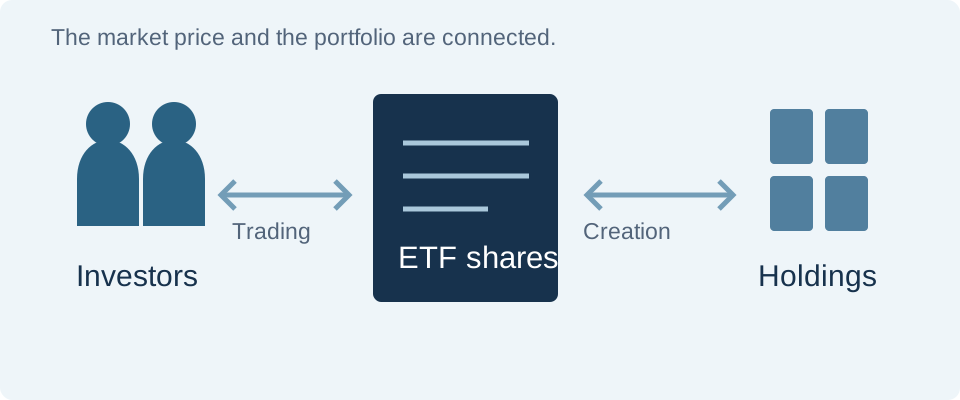
A large cash distribution can look like an investment earning its keep. With a covered call ETF, that judgment requires a second step: establish what happened to the investment as a whole. The option premium comes with an exposure tradeoff, and the published payout rate does not measure the resulting gain.
- A distribution rate describes cash paid under a stated calculation; total return addresses investment gains and losses.
- The premium provides limited cushioning while the written call can constrain participation in a rising market.
- A cashflow objective can justify the tradeoff, but product design and variable distributions still matter.
The distribution label determines what is being measured
Global X distinguishes the annualised rate based on its latest distribution from the fund's investment return. Its QYLD page also separates that rate from a measure using distributions across the preceding year. These calculations describe payments relative to a stated fund value. The issuer reports investment performance using reinvested income, giving the return measure a different job from the payout headline. [1]
Even comparing payout rates requires care. Schwab Asset Management explains that providers differ over whether distribution yield includes capital gains. If competing figures use different definitions, ranking their size does not establish which fund delivers more recurring income on a comparable basis. That measurement problem comes before interpreting differences in cash receipts: the ranking should begin with comparable definitions, rather than assuming the same label means the same calculation. [7]
The premium changes the equity payoff
Fidelity's stock example combines ownership of the underlying investment with a call written against it. The seller receives a premium and accepts an obligation to deliver shares at the agreed exercise price if exercised. Fidelity relates the strategy to an outlook for limited appreciation or little price movement. The example connects the cash premium to the obligation accepted by an existing shareholder. [3]
The Options Industry Council makes the tradeoff sharper: a more distant exercise price preserves more potential appreciation but produces a smaller premium and less cushioning against a decline. For comparable positions, a larger premium cannot therefore be treated as a free improvement. It may reflect accepting a tighter limit on gains. Evaluating the payment without its exercise terms discards the concession that helps explain it. [2]
The strongest defence begins with the cashflow objective
J.P. Morgan describes JEPI as seeking monthly payments through option premiums together with dividends from large American companies. Its equity selection process pursues a portfolio with lower volatility. These are stated product objectives and construction choices, without guaranteeing future payments or performance. They show why an income fund can have a purpose beyond maximising participation in a broad equity rally. [4]
Consider an investor who prefers receiving premium income to retaining all potential appreciation in the covered shares. Under that preference, the forgone upside is an accepted part of the objective, rather than evidence that the strategy failed. The Council's description supports this defence. Its force depends on accepting the exposure concession; it does not turn a larger cash receipt into proof of superior wealth creation. [2]
Rising payments can accompany an uncomfortable market
BlackRock explains that increased volatility can raise option premiums and sometimes covered call ETF distributions. It also warns that strong equity advances can leave covered call strategies behind traditional equity ETFs, while premiums may cover only some losses in a broad decline. The income opportunity and the investment risk can consequently be present together. An elevated payment does not establish that the underlying market exposure has become safer. [8]
Suppose a fund continues making substantial distributions while its reported total return remains disappointing. Global X's distinction means those observations can coexist without contradiction: the payment rate never purported to measure the complete gain or loss. The relevant assessment concerns the investment outcome including distributions. Treating the cash payment as an additional return on top of a performance figure that already reinvests income would count the same payment twice. [1]
The fund's design belongs in the explanation
The SEC's ETF bulletin distinguishes portfolios managed to track an index from portfolios whose managers select investments under an active objective. It also distinguishes the portfolio value represented by NAV from the price paid in a market transaction. Those distinctions apply to evaluating fund results: the strategy's mandate, its portfolio valuation and the investor's traded share price describe related parts of the investment, with different measurement roles. [5]
Attributing every performance gap to the call overlay would be premature. JEPI describes a stock selection process, and its factsheet identifies liquidity and counterparty risks in equity linked notes. If a comparison changes both the equity portfolio and the income implementation, it cannot isolate the effect of writing calls. The cashflow thesis then needs examination alongside portfolio selection and instrument risk, rather than explaining the result with yield. [4]
A shareholder's result also depends on the comparison convention
Vanguard distinguishes the price available to a buyer from the price available to a seller, with the difference forming the trading spread. It separately describes the expense ratio as a measure of fund expenses relative to assets. A published investment result and an investor's transaction consequently involve distinct cost concepts. Portfolio operating expenses and the prices available when entering or leaving a holding belong to different parts of that assessment. [6]
The return convention must stay consistent when examining costs. J.P. Morgan states that its NAV performance incorporates management and operating expenses but excludes brokerage commissions. Deducting operating expenses again would understate that result. Conversely, reinvested performance and a household spending its distributions describe different uses of cash. The former supplies a comparison convention; it does not establish the latter household's remaining wealth or payment adequacy. [4] [1]
What would change the interpretation
For an accumulation objective that values participation in equity appreciation, the premium needs a stronger defence because the written call gives away part of that payoff. A less restrictive exercise price changes the concession, while reducing the premium available. This gives priority to the exposure retained over the distribution advertised. A smaller payout could accompany a design better aligned with that objective, without establishing any future performance ranking. [2]
The competing cashflow interpretation deserves greater weight when the investor accepts constrained appreciation and the actual fund design matches that preference. BlackRock identifies the proportion covered by calls, exercise prices and portfolio construction as consequential choices; distributions also vary with market conditions. Evidence about those choices and the realised payment pattern would sharpen the assessment. A high quoted rate alone cannot establish either a suitable exposure tradeoff or dependable future cash receipts. [8]
Editorial assessment. The assessment turns on which exposure the investor means to retain. When wealth accumulation and equity participation are the objective, a large payout supplies weak evidence of success because the premium can accompany surrendered appreciation and continuing downside risk. When receiving cash is itself part of the objective, that same exchange can be coherent, provided its limits are accepted and variable payments remain visible. The decisive comparison follows the complete investment result and the fund's actual construction. It cannot be settled by ranking distribution rates.
Evidence scope. This analysis uses issuer disclosures and educational explanations to assess mechanisms, rather than estimating current relative performance. JEPI's construction and note risks are product specific; stock option delivery examples do not describe every fund's settlement arrangements. No payment forecast, household withdrawal plan or measured advantage for any market regime is established here.
How to review a completed backtest
Sources and further reading
- Global X Nasdaq 100 Covered Call ETF (QYLD): distribution definitions and total return
- Covered Call (Buy/Write)
- What is a covered call?
- JPMorgan Equity Premium Income ETF fact sheet, September 30, 2026
- Updated Investor Bulletin: Exchange-Traded Funds (ETFs)
- ETF fees and minimums
- Evaluating ETF yield
- Covered call ETFs explained for income investors