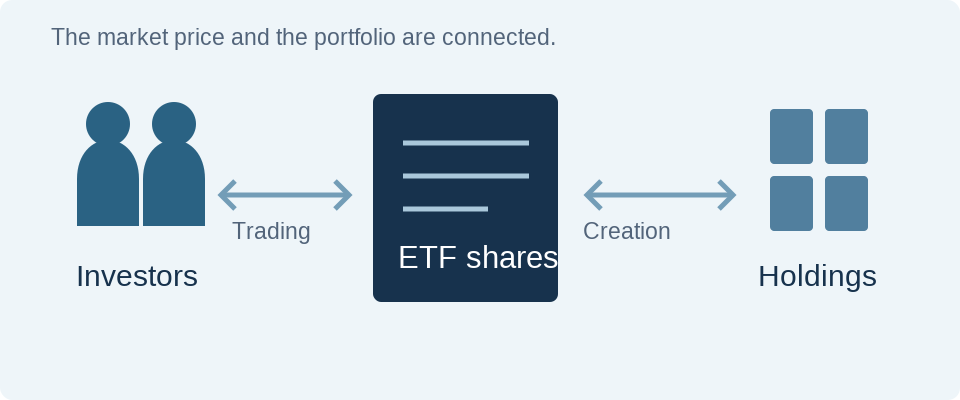
ETF shares give investors a claim on a portfolio. The intended holding exists only after the purchase executes. A satisfactory price boundary therefore leaves an important question open when the shares never arrive.
- A limit controls the permitted price while leaving execution uncertain.
- The remaining holdings determine the exposure after an incomplete rebalance.
- A stale valuation reference can make waiting for a discount misleading.
Price control and completion
FINRA distinguishes the priority of a market order from the boundary imposed by a limit. The former seeks immediate execution at the available price without assuring that price. The latter permits execution only at the limit or better, with a chance of no trade. Price protection and completion are separate properties of the instruction. (FINRA)
Fidelity explains that reaching a limit price does not ensure execution. Market centres apply sequencing rules, and orders depend on an available market. Its order documentation also describes partial fills and instructions that restrict whether an order may execute in pieces. (Fidelity)
The SEC describes an ETF share as a proportionate interest in the fund portfolio and retail purchases as market transactions. On those premises, submitting a purchase is insufficient to establish the intended holding. An unexecuted instruction provides no additional ownership, even when the intended fund exposure and its investment case remain unchanged. (SEC)
The portfolio after a partial fill
For an order that fills in pieces, the useful unit of assessment is the completed quantity together with the remainder. Conditional on the remainder staying open, a favourable fill on the completed portion cannot establish that the whole intended trade succeeded. The execution record needs both quantities. (Fidelity)
The SEC explains that changes in relative investment values can move holdings away from their original allocation and alter portfolio risk. Rebalancing seeks to restore that mix. It also cautions that owning an ETF does not necessarily deliver diversification, particularly when the fund has a narrow focus or overlaps other holdings. (SEC)
If a planned sale is meant to reduce an unwanted concentration, an unfinished sale leaves some of that exposure in place. If a planned purchase is meant to restore another allocation, an unfinished purchase leaves that restoration incomplete. This conditional reading judges the actual holdings against the stated objective without predicting which asset will perform better. (SEC)
A quote needs a trading setting
Schwab Asset Management connects wider opening spreads with the difficulty of pricing holdings that have not all started trading. It also identifies the liquidity of underlying securities and differences in trading hours as relevant to ETF liquidity. Average exchange volume alone therefore gives an incomplete picture of the setting in which an order competes. (Schwab Asset Management)
Vanguard distinguishes market makers, which display ETF purchase and sale quotes, from authorised participants, which can create or redeem fund shares. Its framework connects exchange trading with the underlying basket through those roles. This describes a mechanism for supplying liquidity. It does not promise that an individual order will find its full quantity at its chosen price. (Vanguard)
Valuation gaps can weaken a waiting rationale
BlackRock explains that an apparent premium or discount can reflect different valuation times. An exchange traded product can also provide price discovery while the reference value lags. Its account allows for both actionable arbitrage opportunities and optical gaps. A difference from reported net asset value does not settle which interpretation applies. (BlackRock)
Deutsche Asset Management makes the alternative especially clear for international equity ETFs. Its FAQ describes the ETF continuing to discover fair value after the underlying market closes, including through European futures. It consequently argues that underlying market closure need not require waiting to trade. This is a provider explanation of the mechanism, rather than a guarantee for every order. (Deutsche Asset Management)
For a purchase, a stale reference below current asset value could keep a limit too low to execute. For a sale, an optical discount could make a fair price look unattractive. Neither case establishes that waiting will improve the price. A genuine valuation gap would require a separate explanation of why delay could benefit that particular purchase or sale. (BlackRock)
An urgency assumption changes the comparison
FINRA’s distinction implies a real competing case for prioritising completion when a price boundary repeatedly prevents execution. That case strengthens if the mandate assigns a high cost to remaining unfinished. It still accepts uncertainty about the eventual price. A deadline changes the objective being evaluated, without establishing that every available price is acceptable. (FINRA)
Evidence that could change the assessment
An execution record would first have to show how much of the intended ownership change remains undone and whether that remainder still matters to the allocation objective. If completed purchases or sales already establish the required portfolio interest, the assumed urgency weakens. If the intended interest remains absent at the decision deadline, the case for waiting needs a stronger justification. (SEC)
A confirmed stale valuation time would weaken a purchase rule that waits for yesterday’s reference price. A contemporaneous valuation would remove that objection without proving that a gap will close. That distinction changes the reason for waiting. (BlackRock)
Waiting becomes more defensible if the still unfilled quantity can remain outside the intended allocation until an identifiable improvement in trading conditions, such as underlying holdings opening. If the exposure deadline arrives first, that justification weakens. The decisive observation is the timing of the expected information relative to the deadline, rather than a later hour alone. (Schwab Asset Management)
Executable depth would then qualify the completion case. If it supports the remaining quantity within the accepted price boundary before the deadline, an assumed need to choose between speed and an unacceptable price weakens. If depth is insufficient, that reassurance disappears. This proposed comparison needs quantity specific quotes, rather than an assurance based on the fund’s name. (Deutsche Asset Management)
Editorial assessment. Waiting deserves greater weight when identifiable liquidity information could improve within the permitted interval. Completion deserves greater weight when the exposure deadline is binding and available depth supports the quantity. Neither assessment follows from comparing the limit with a stale reference price.
Evidence scope. This is a conditional assessment of order mechanics and portfolio objectives. It estimates no fill probability, missed return or execution shortfall. No current order book, broker routing record or investor deadline is examined. The educational documents describe mechanisms and provider practices whose application depends on the fund, venue and order terms.
Related research on ETF ownership costs
Sources and further reading
- Updated Investor Bulletin: Exchange-Traded Funds (ETFs)
- Trading FAQs: Order Types
- Best practices for trading ETFs
- ETF trading guidance and best practices: A framework for approaching execution
- All about ETPs: Premiums and discounts
- Capital Markets FAQ
- Understanding Order Types Can Save Time and Money
- Asset Allocation and Diversification