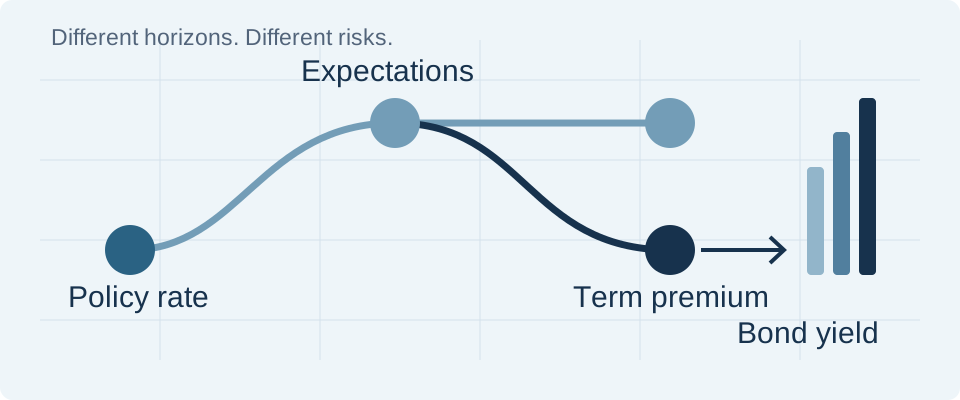
A bond with modified duration of 10 years gains roughly 5% when its yield falls by 50 basis points in the DMO's illustration. That is an approximation conditional on the yield move. It does not establish that a policy cut will deliver the move, that the price response is exactly linear or that the holder earns that gain after financing.
- Duration measures an approximate price response to a stated yield scenario.
- Equal total yield changes have the same duration approximation regardless of their attributed components.
- A policy headline cannot substitute for a total yield scenario or a full holding return calculation.
Read the units before reading the policy headline
The DMO explains bond duration and yield changes with an explicit illustration: modified duration of 10 years and a 50 basis point yield decline imply an approximate 5% price increase. The yield change is expressed in percentage points when used in that percentage price calculation. The calculation answers how a price responds if the assumed yield move occurs. It supplies no forecast of the move itself. [7]
The approximation also has a geometric limit. Duration describes a straight line sensitivity, while the DMO identifies a curved relationship between yield and price. For larger changes, treating the first sensitivity as an exact valuation can therefore misstate the response. The example should retain its approximate label. A precise price claim would need the actual security and a valuation that recognises the curve. [7]
Price sensitivity is also narrower than the holder's return. Because this calculation maps yield into price, it leaves income received and the cost of financing outside the answer. A holder would need those additional cash flows to judge the full outcome. Calling the example a 5% investment return would quietly enlarge the calculation beyond what it measures, even if its approximate price result were accurate. [7]
The same price scenario can have different explanations
Federal Reserve research separates a bond yield into expected shorter rates and compensation beyond that expectation. Its survey approach measures the former from professional forecasts and assigns the difference to a premium. The study finds a substantial role for premia in yield variation. That is a reason to challenge a protection thesis which assumes that longer yields merely repeat the direction of the next policy decision. [2]
Consider two conditional explanations for an identical decline in the bond's total yield. One attributes it mainly to lower expected shorter rates; the other mainly to reduced premium compensation. Holding the bond and total change fixed leaves the duration approximation unchanged. The attribution instead affects the economic story about why the move might occur and last. Neither scenario here assigns new numerical values to the components or estimates their probabilities. [2]
The Federal Reserve's announcement research distinguishes news about the current target from news about the future policy path. Statements have particularly important effects on longer Treasury yields in its historical event study. A position intended to benefit from policy therefore needs the path surprise specified. The announced action alone does not tell a holder how much information about future settings has changed or how the relevant bond yield will respond. [1]
What could offset the expected rate benefit?
The BIS duration supply mechanism offers a concrete competing scenario. If more maturity exposure reaches private balance sheets, the compensation required to hold it could change. A thesis built on lower expected rates would then have to allow for a premium response rather than assume the whole longer yield follows policy. This scenario needs evidence about the exposure actually available after official holdings, not just the nominal financing announcement. [3]
BIS research on government debt demand examines how investor sectors absorb supply as yields adjust. The response depends on the sensitivity and composition of demand. This makes the buyer side relevant to the offset scenario. A supply increase is an incomplete explanation until the account identifies the demand expected to meet it. The historical research does not supply a universal yield response for a present change in issuance. [4]
If evidence showed unchanged private duration exposure, that would weaken a supply explanation based on greater risk absorption. If exposure increased, it would support the premise without establishing the price effect. This distinction matters to protection: a portfolio dependent on falling yields needs the whole scenario to survive, rather than one plausible catalyst. Duration quantifies the exposure to the outcome; it does not complete the missing argument about supply. [3]
An estimated component cannot certify the scenario
The BIS account of term premium estimation warns that different specifications and uncertain parameters affect the result. Estimates can also change as parameters and macroeconomic data are revised. A decomposition downloaded later may therefore differ from the one available when the position was chosen. The observed yield and its estimated explanation deserve separate records, especially when protection is justified by a historical chart of the premium. [5]
If the claimed protection survives only one decomposition, confidence should depend on that fragility. Agreement across defensible methods would strengthen the interpretation but would still leave the prospective total yield move uncertain. Disagreement would make it harder to assert that one catalyst dominates. This is a proposed sensitivity assessment drawn from the BIS caveats, rather than a current comparison of models or a claim that an estimate directly reveals the cause. [5]
Judge protection over the exposure's actual horizon
The IMF's macroeconomic term structure research links premia to expected growth, inflation and policy. It describes an inflation surprise that can bring faster tightening and a repricing of risk compensation together. That mechanism makes a favourable expected rate story conditional on the wider economy. The paper's model does not establish a present forecast; it explains why policy and premium assumptions should be economically consistent over the horizon being assessed. [6]
Buyer conditions would help distinguish a durable absorption story from an assumed premium reversal. If the proposed source of demand does not appear, the scenario needs revision even when the policy forecast remains intact. The BIS demand research makes that a material question about who can hold the exposure and at what price. A protective role should receive less confidence when its success requires a buyer response that the evidence has not established. [4]
The strongest conditional case for a policy related bond benefit is one in which growth and inflation evidence supports the assumed path and the premium does not erase it. The competing case is an inflation or risk compensation shock that frustrates the expected yield decline. These imply different vulnerabilities for a holder with duration exposure. The IMF mechanism supports examining that conflict, while the eventual price and holding return still require the bond's own inputs. [6]
Editorial assessment. For a protection claim, the decisive assumption is the net change in the bond's own yield over the relevant holding period. A policy path narrative deserves more weight when the expected rate component moves in its direction without an offsetting premium change. A premium or supply narrative deserves more weight when the evidence supports that offset instead. Neither interpretation alters the duration arithmetic for an identical total move. They change the confidence placed in the scenario and the evidence required to call the position protective.
Evidence scope. The duration figures are the DMO's stated illustration, rather than a current bond quote or a new numerical scenario. No current duration, convexity, income stream, financing contract or yield decomposition is calculated. Historical policy and supply studies do not establish the probability of a present move, its persistence or the effectiveness of a hedge.
Sources and further reading
- Do Actions Speak Louder Than Words? The Response of Asset Prices to Monetary Policy Actions and Statements
- The Term Structure of Expectations and Bond Yields
- Government bond yields and the dynamics of duration supply
- The demand for government debt
- Term premia: models and some stylised facts
- A Macroeconomic Approach to the Term Premium
- Gilt Review 1998–1999